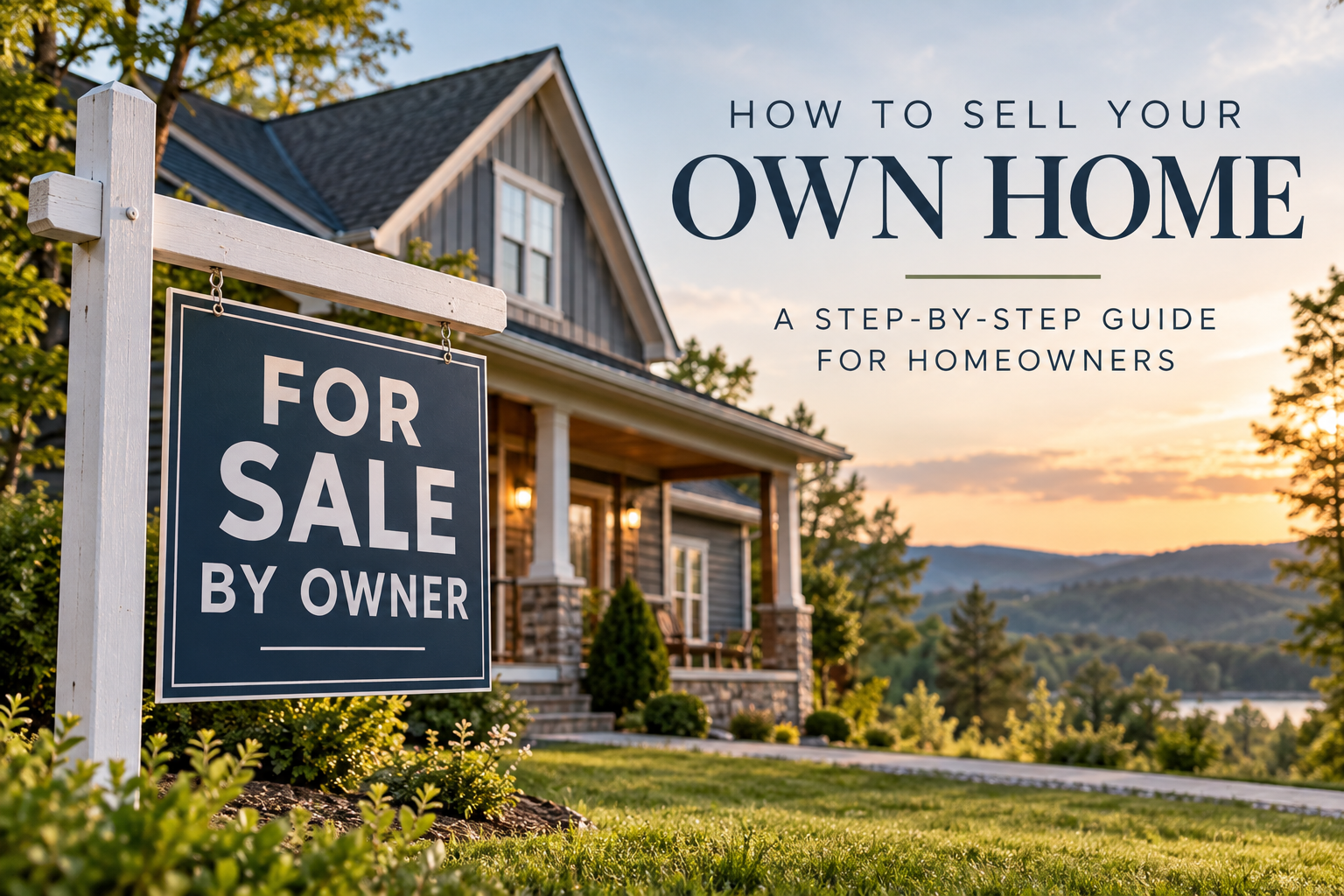
Thinking about selling your house without a REALTOR®?
You absolutely can.
Selling a home yourself, commonly called For Sale By Owner or FSBO, can save you the cost of hiring a listing agent. But before putting a sign in the yard and posting your home online, it is important to understand exactly what you are taking on.
Selling a home involves a lot more than finding someone willing to buy it. You need to determine the right price, prepare the property, market it, screen potential buyers, handle inquiries and showings, evaluate offers, negotiate terms, manage inspections and other contingencies, coordinate with the buyer’s agent, lender and title company, and keep the transaction moving toward closing.
If you’re considering selling your own home, here’s how the process generally works.
Step 1: Figure Out What Your Home Is Actually Worth
This is probably the most important decision you will make when selling your home.
You can start by looking at recently sold properties in your area that are similar to yours in location, size, condition, age, acreage, features and overall appeal.
The key word here is sold.
What another homeowner is asking for their house doesn’t necessarily tell you what buyers are willing to pay for yours. Active listings can help you understand your competition, but comparable closed sales are generally much more useful when determining market value.
Online home estimates can give you another point of reference, but they don’t know that you remodeled your kitchen, need a new roof, have an unusually private backyard or that the house down the road isn’t really comparable to yours.
Try to look at your property as objectively as possible. Pricing based on what you paid, how much you’ve invested into the home or how much money you need to walk away with doesn’t necessarily translate into market value.
Pricing too high can cause a home to sit on the market, while pricing too low can leave money on the table. The goal is to find the price that makes sense based on the property and the current local market.
Step 2: Get the House Ready to Sell
You don’t necessarily need to renovate your house before selling it.
In many cases, simple things make the biggest difference.
Declutter. Clean thoroughly. Take care of obvious deferred maintenance. Touch up paint where needed. Clean up the landscaping. Remove excessive personal items and make each room feel open and easy for a buyer to understand.
You want buyers walking through the house thinking about living there, not thinking about the list of things they’ll need to fix after closing.
This is also the time to gather information buyers may ask for, such as utility information, permits, septic records, well information, HOA documents, warranties and information about major improvements.
The more organized you are before the house hits the market, the easier it will be to answer questions once buyers start showing interest.
Step 3: Complete the Required Seller Disclosures
If you’re selling a home in Pennsylvania, this is an especially important step.
Pennsylvania law generally requires residential sellers, subject to certain exceptions, to provide buyers with a property disclosure statement addressing known material defects. The disclosure must generally be provided before the buyer and seller sign an agreement of transfer.
The goal isn’t to scare buyers away by listing every little thing that has ever happened to the house. It’s to accurately disclose what you know about the property and comply with your obligations as the seller.
Selling your home yourself does not eliminate those responsibilities.
If you aren’t sure what you’re legally required to disclose or how a contract affects your rights and obligations, this is an area where getting appropriate professional advice can be worthwhile.
Step 4: Take Good Photos and Market the Property
Good real estate marketing should do more than announce that a house is for sale.
Your photos should make someone want to see the property in person. Your description should highlight what makes the home worth considering without exaggerating or misrepresenting it.
Think about the things a buyer would actually want to know.
How many bedrooms and bathrooms are there? How much land? What type of heating and cooling does it have? Is there a garage? Is it in an HOA? Is there a well and septic system or public utilities? What school district is it in? What improvements have been made?
Then you need to get that information in front of buyers.
You can use FSBO websites, social media, signs and other advertising methods. Just remember that posting a house for sale and actually marketing a house are two different things.
The goal isn’t simply to get views. It’s to get the property in front of qualified buyers who may actually want to purchase it.
Step 5: Screen Buyers and Be Prepared to Handle Showings
Once the home is advertised, you’re the point of contact.
That means answering inquiries, coordinating appointments and deciding who you are comfortable allowing into your home.
One step homeowners sometimes overlook is making sure prospective buyers are actually in a position to purchase the property.
If someone plans to finance the home, you may want to request a current mortgage pre-approval before scheduling a private showing or seriously considering an offer. If someone says they are paying cash, ask for proof of funds showing that they have the financial ability to complete the purchase.
This isn’t about making the process difficult for buyers. It helps separate serious, qualified buyers from people who may simply be browsing.
You will also need a system for scheduling showings, keeping track of who has been inside the property and providing access while protecting your own privacy and security.
And keep in mind that selling without your own agent doesn’t necessarily mean you’ll be dealing directly with buyers.
According to the National Association of REALTORS®’ 2025 Profile of Home Buyers and Sellers, 88% of buyers purchased their home through a real estate agent or broker.
That means there’s a good chance you’ll be communicating and negotiating with an experienced buyer’s agent even though you don’t have an agent representing you.
Step 6: Know Who Is Representing Whom
This is something that can be easy to overlook when selling your own home.
If a buyer comes to you with a real estate agent, that agent is generally there to represent the buyer’s interests, not yours.
They may be friendly, helpful and willing to explain parts of the transaction, but their client is the buyer.
As an unrepresented seller, you are responsible for protecting your own interests, understanding what you’re signing and deciding whether the terms being proposed make sense for you.
That doesn’t mean you shouldn’t work with represented buyers. Most buyers use real estate agents.
It simply means you should understand everyone’s role before negotiations begin.
Step 7: Know How to Evaluate an Offer
This is where selling a home starts becoming more complicated.
An offer isn’t just a price.
A $400,000 offer isn’t automatically better than a $390,000 offer.
You need to look at the entire agreement.
Is the buyer paying cash or obtaining financing? If they’re financing, does the offer include a credible pre-approval? If they’re paying cash, have they provided proof of funds?
How much money are they putting down? How much earnest money are they depositing? Are they requesting seller concessions? Is there a home inspection contingency? What about septic, well, radon or other inspections? Is there an appraisal contingency? Are they asking you to make repairs? When do they want to close?
There may also be deadlines within the agreement that determine when inspections need to happen, when deposits are due and when certain decisions have to be made.
The strongest offer is not always the offer with the highest number at the top of the page.
Step 8: Negotiate the Offer
You don’t have to accept an offer exactly as it is written.
You can accept it, reject it or negotiate different terms.
Maybe the price works but the seller concession doesn’t. Maybe you want a larger deposit. Maybe the proposed closing date doesn’t work for you. Maybe you’re comfortable with an inspection but aren’t willing to agree to certain other contingencies.
Negotiation also doesn’t necessarily end when the agreement is signed.
Depending on the contract, inspections, appraisal issues, financing problems and other contingencies can create additional negotiations before you reach the closing table.
This is one of the areas where experience can make a significant difference. Knowing what to push back on, what may be reasonable and what could jeopardize the transaction isn’t always obvious when you’re in the middle of it.
Step 9: Manage Everything Between Contract and Closing
Getting under contract feels like the finish line.
It isn’t.
Once you have an accepted agreement, deadlines start coming quickly. Depending on the transaction, you may need to coordinate deposits, inspections, repair negotiations, municipal requirements, HOA or resale documents, title work, appraisal access, lender requirements, final walkthrough and settlement.
Missing a deadline or misunderstanding a provision in the agreement can create unnecessary problems for both sides.
This is also where communication becomes extremely important. There may be a buyer, buyer’s agent, lender, title company, inspectors, appraiser, municipality, HOA and contractors involved in the same transaction.
Someone has to keep everything moving.
So, Is Selling Your Own Home Worth It?
For some homeowners, it can be.
If you already have a buyer, understand real estate contracts, know the local market and are comfortable handling negotiations and transaction management, selling without a listing agent may make sense.
That distinction is important when looking at FSBO statistics.
According to the National Association of REALTORS®’ 2025 Profile of Home Buyers and Sellers, only 5% of home sales were For Sale By Owner, while 91% of sellers used a real estate agent. The remaining sellers used other methods, including direct sales to home-buying companies and other types of transactions.
There’s another interesting part of that data: 60% of FSBO sellers already knew the person buying their home.
Selling your house to a family member, friend, neighbor or tenant is very different from putting a property on the open market, competing against other listings and trying to attract qualified buyers you have never met.
NAR also reported a median selling price of $360,000 for FSBO homes compared with $425,000 for agent-assisted sales.
That doesn’t mean hiring an agent automatically adds $65,000 to the value of a house. The properties and circumstances behind those sales aren’t identical, and factors such as location, property type and whether the seller already knew the buyer can affect the numbers.
But it does raise an important point.
When deciding whether to sell on your own, commission shouldn’t be the only number you’re looking at.
The better question is:
What am I likely to walk away with at the end of the sale, and what am I taking on to get there?
What Does a Good Real Estate Agent Actually Do for a Seller?
A good listing agent isn’t just putting your house on the MLS and waiting for someone else to sell it.
Your agent should be helping you determine a realistic pricing strategy based on current local data, preparing the home for the market, creating professional marketing, exposing the property to buyers and other agents, coordinating showings, verifying buyer qualifications, collecting feedback, evaluating activity, helping you understand offers, negotiating on your behalf and managing the transaction from listing through settlement.
There is also something to be said for having another person between you and the buyer.
Selling your own home can become personal very quickly. It’s your house, your money and often a place where you’ve spent years of your life.
A REALTOR® can look at the transaction from a different perspective and negotiate based on the deal rather than the emotion attached to it.
And when the buyer has their own agent, having someone on your side means you aren’t negotiating alone with a professional whose job is to represent the other party.
Selling a Home in the Poconos?
Selling property in the Pocono Mountains can come with its own set of considerations.
Depending on the property, you may be dealing with an HOA or private community, short-term rental considerations, well and septic systems, private roads, acreage, vacation-home buyers, investment buyers or buyers coming from outside the area.
Knowing the local market matters.
At Anchors & Acres Real Estate®, we’re a locally owned real estate brokerage serving homeowners throughout the Poconos and surrounding areas. We believe sellers should understand their options, whether they ultimately decide to sell on their own or hire us to handle it.
If you’re thinking about selling, we’d be happy to take a look at your property, discuss what comparable homes are actually selling for and give you an idea of what your home could realistically bring in today’s market.
There is no pressure and no obligation to list.
Sometimes the best first step is simply finding out what your house is worth and what your options look like.
Thinking About Selling Your Home?
Let’s talk about your property, what it’s worth and what selling could look like in today’s market.
Kyle & Jen Coover
Owners · PA & FL REALTORS®
Anchors & Acres Real Estate®
Call or text: 570.355.1640
Email: hello@anchorsandacres.com